How to Trade Meme Coins With a Tiny $10 Portfolio Without Fees Eating the Profit
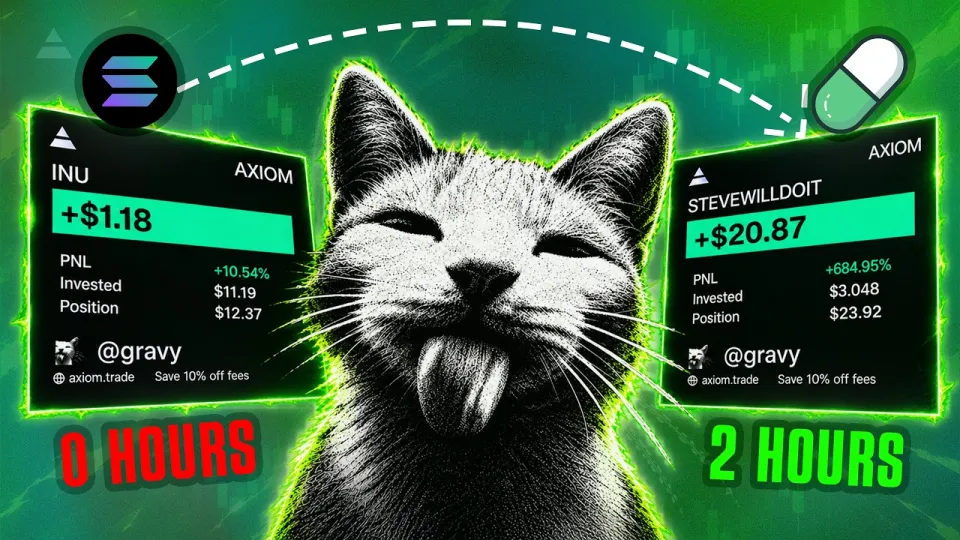
Video: I Tried Trading Memecoins with Just $10
You can order the same kind of articles for your own video to boost it on YouTube and Google. Just message the Telegram bot @sat_sit_bot. Articles with your video embedded are written and posted by the bot itself — on popular topical sites (no ads). Try it free: 50 articles on us.
· based on the channel gravy
You can trade meme coins with $10 if you treat each buy as a lottery ticket rather than an investment: keep every position at or below 0.05 SOL, only enter coins with a live narrative, and take profit in tranches before the crowd does. That is exactly the experiment the channel gravy ran in its video “I Tried Trading Memecoins with Just $10” — five real trades on Solana, each buy capped at 0.05 SOL, executed through Axiom's trading terminal, where the referral link gives cashback and a fee discount.
The point of the exercise is not to get rich from ten dollars. It is to prove that the fee argument — “small accounts get eaten alive by gas and taxes” — is mostly wrong on Solana, where a swap costs cents. What actually kills small portfolios is bad sizing and undisciplined exits.
Why the $10 experiment is a real test of meme coin trading
A $10 account forces you to confront the only two variables that matter in meme coin trading: how much you risk per trade and how fast you exit. With 0.05 SOL positions on a roughly $10 bankroll, one bad trade costs a few percent of the account, not half of it. That asymmetry is the entire strategy.
Here is the math that makes small-account meme coin trading viable on Solana:
- A standard swap fee plus priority tip on Solana typically lands in the cents range, often under $0.05 combined for a simple buy or sell.
- A 0.05 SOL buy at, say, $200 per SOL is about $10 — meaning one position is your whole account, which is why the experiment spreads across five separate trades rather than one all-in.
- If a position doubles, selling half recovers the original stake and leaves a free runner; that is the only way a sub-$20 account compounds.
- Slippage, not gas, is the hidden cost: thin meme coin liquidity can cost 5–15% on entry and exit if you market-buy into a new pool.
That last point is what most beginners miss when they complain that fees destroyed their trade. On a low-cap meme coin, the spread and the price impact are the tax.
The five trades and what each one teaches
The gravy run is a compact syllabus in narrative trading: every buy had a reason tied to a story circulating on X, not to a technical setup. The coins were STEVEWILLDOIT, NPC, MET (Meteora), PUMPY the Trader and UNTXD — all Solana meme plays launched in the pump.fun era and traded through a terminal rather than a clunky DEX interface.
- STEVEWILLDOIT was the narrative trade. The coin rode the “X Money” meta, which spread through the e/acc corner of crypto Twitter and the Cream crowd — the same circle that pushes payment-infrastructure and AI-adjacent memes. Buying early in a meta that is visibly spreading is the closest thing meme coins have to an edge.
- NPC was the follow-the-trend trade: a coin whose name maps onto an internet meme everyone already knows, which lowers the explanation cost and speeds up virality.
- MET (Meteora) was the infrastructure-adjacent play — a meme built on top of a recognizable Solana brand, which gives it a built-in search audience.
- PUMPY the Trader leaned on the pump.fun culture itself, a meta that recurs because the launchpad is where the audience already lives.
- UNTXD was the late-cycle attempt, and the one the creator admits fumbling badly — the lesson there is about execution and exits rather than coin choice.
The pattern across all five: the entry thesis fits in one sentence, and the coin is found where the narrative is being discussed, not on a screener sorted by volume.
How to find meme coins with a narrative before the crowd
The single most common complaint from small-account traders is that by the time they spot a good narrative, the move is over — they buy the dip, everyone else sells, and the coin never comes back. Fixing that requires a process, not more screen time.
- Curate your X feed ruthlessly. Follow accounts that post early, not accounts that post recaps. If your timeline is full of noise, build a list of 20–30 traders who consistently surface coins within the first hour.
- Track who has influence, not just what is trending. A meme coin lives or dies on whether the accounts with reach pick it up. Keep a short mental list of the people whose quote-tweets actually move a chart.
- Write the thesis in one line before buying. If you cannot explain why this coin pumps in a single sentence, you are the exit liquidity.
- Check the pool, not just the chart. Look at liquidity, holder distribution and whether the top wallets are fresh. Thin liquidity plus concentrated holders is a rug waiting to happen.
- Enter small and early. A 0.05 SOL position taken on the first day of a meta beats a 0.5 SOL position taken on day three.
Narrative timing is the real skill. The X Money meta ran because it connected a real product narrative (payments) with a community that loves accelerationist memes; that combination gave the coin a reason to be shared beyond the usual degen circle.
Position sizing and exit rules for a small portfolio
Discipline is what separates a $10 experiment that teaches you something from a $10 donation to early sellers. The rules below are the ones that make a sub-$20 account survivable.
- Cap each buy at 0.05 SOL. One position should never be more than a meaningful slice of the account, even if that means running several trades instead of one.
- Sell in tranches. Take a third or half off at the first strong leg, recover the stake, and let the rest run with a mental stop at breakeven.
- Set a hard invalidation level before entry. If the coin loses the level that made the setup valid, exit — do not wait for a bounce that the crowd has already priced out.
- Never average down into a meme coin. Adding to a loser is how small accounts become zero accounts.
- Log every trade. Entry reason, exit reason, and the emotion at the moment of selling. The pattern in your own log is worth more than any signal group.
The fumbled trade in the gravy run is the best illustration: the thesis was fine, but the exit was late and the position was handled loosely. That is the failure mode small traders repeat most often — not picking the wrong coin, but holding the right one too long.
Common questions small-account traders ask
Beginners arriving at meme coin trading usually share the same doubts, and most of them come down to process rather than capital. The recurring themes: how to build a useful Twitter feed instead of an overwhelming one, whether a $10 account is worth the effort at all, and how to stop selling at a 20–40% loss right before a coin runs.
The honest answers: your feed is a tool you have to prune weekly; a small account is a training ground where mistakes are cheap; and the “sold too early, it ran later” feeling fades once you define exits in advance instead of reacting to the chart. Consistency in meme coin trading comes from repeatable rules, not from finding better coins.
One more practical note: use a terminal that shows you liquidity, holders and socials in one place. Trading through a bare DEX interface on a phone is how people accidentally buy the wrong contract.
Useful links from the video
- Axiom trading terminal (referral, cashback and fee discount): https://axiom.trade/@gravy
- The Trenches Discord: https://discord.gg/W7TqkExcSd
- Discord with free Axiom imports and trade signals (NFA): https://discord.gg/9W5j3XUgYB
- Creator's X account: https://x.com/gravyski
- Leverage trading with reduced futures fees: https://www.bitbase.com/landing-page/trading-earning-Gra?ref=8CYOGY
Bottom line
A $10 portfolio is enough to learn meme coin trading properly, because Solana fees are cents-level and the real constraint is sizing and exits, not capital. The gravy experiment shows the workable formula: five trades, each capped at 0.05 SOL, every entry tied to a narrative you can state in one sentence, and profit taken in tranches rather than held for a fantasy multiple. The one badly handled trade in the set is the most useful part of the video, because it shows that execution errors cost more than gas ever will. If you want to run the same experiment, start with a terminal that gives you the data up front — Axiom is the one used in the video — and keep a log from trade number one. The channel gravy is worth following for more of these small-account breakdowns.
Key takeaways
- Five real meme coin trades, each buy kept at or below 0.05 SOL, so the whole experiment ran on roughly $10.
- Coins covered: STEVEWILLDOIT, NPC, MET (Meteora), PUMPY the Trader and UNTXD — all Solana meme plays.
- The X Money meta narrative (e/acc and Cream) is what drove the STEVEWILLDOIT entry, not chart patterns.
- One trade was fumbled badly — the mistake was in execution and exits, not in the coin selection itself.
- Solana fees and priority tips are cents-level, so a 0.05 SOL position can still be profitable if the exit is disciplined.
Source: I Tried Trading Memecoins with Just $10 · Markdown version
Questions & answers
Can you actually make money trading meme coins with only $10?
Yes, but the goal is learning, not income. On Solana a swap costs cents, so a 0.05 SOL position can still return a profit if the narrative is early and the exit is disciplined. The realistic outcome of a $10 account is a cheap education in sizing and exits.
How do I stop selling at a 20–40% loss right before a coin runs?
Define your exit and your invalidation level before you enter, and size the position so a full loss does not hurt. If you sold because the thesis broke, the later run is irrelevant; if you sold out of fear, your position was too big for your stomach.
How do I find meme coins with a good narrative without drowning in Twitter?
Prune your feed to a short list of accounts that post early rather than recap, and track which of them actually move prices when they post. Write the thesis for any candidate in one sentence; if you cannot, skip the trade.
What fees should a small meme coin trader expect?
On Solana, network fees plus priority tips usually total a few cents per swap, so gas is not the problem. The real costs are slippage and price impact on thin liquidity, which can take 5–15% on entry and exit in a new low-cap pool.